American Warlords by Jonathan W. Jordan
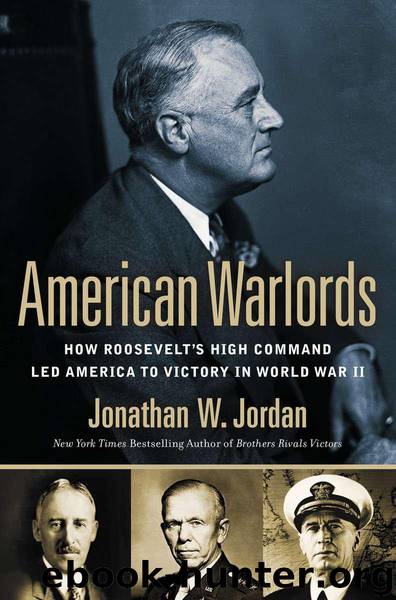
Author:Jonathan W. Jordan [Jordan, Jonathan W.]
Language: eng
Format: epub
Tags: History, Nonfiction, Retail, WWII
ISBN: 9780451414571
Barnesnoble:
Publisher: Penguin Publishing Group
Published: 2015-05-05T04:00:00+00:00
THIRTY-NINE
RENO AND GRANITE
THE SHORTEST DISTANCE BETWEEN TWO POINTS IS USUALLY A STRAIGHT LINE. On Admiral King’s charts, the straightest line from Pearl Harbor to downtown Tokyo ran through the Central Pacific. Nimitz’s Central Pacific.1
By the fall of 1943, Nimitz’s marines were closing in on Makin and Tarawa, the last holdouts of the Gilbert Islands. Their capture would pave the way to the Marshall and Caroline islands, which included the formidable naval base on Truk. After the Carolines, the Navy’s next ports of call would be the Palaus, to the south, and the Mariana Islands—Saipan, Tinian, and Guam—which Nimitz hoped to reach by November 1944.
As King saw it, with the Marianas in American hands, the Navy could push through to the Philippines and coastal China. Bases in China would complete the encirclement of Japan. The Home Islands would starve, and their cities would fall under the bombsights of Hap’s new B-29s. The war would be as good as over.2
GRANITE, Nimitz’s Central Pacific plan, made the most of the mobility and striking power of the carrier fleet that King had husbanded since Pearl Harbor. It required comparatively little “lift,” and allowed American airpower to do much of the heavy demolition work.3
But the realist in King knew Japan would not sit still as Nimitz hopped from Makin to Honshu. In his cabin late at night, that realist kept asking, “Where would the Japanese turn and fight?”
Picturing the great ocean from Japan’s point of view, King felt the Imperial Navy might let the United States reach the end of its supply tether before delivering a knockout punch. For that reason, he did not think the enemy fleet would sally too far east of the Philippines, much as he would love to see them try. “Because we would like them to come out is no military reason why they should do as we wish,” he reminded his journalist friends one evening. “Also—and maybe more important—the Japs have had a taste of what a wallop the American Navy packs and does not like the taste.”4
• • •
The American Navy packed a wallop, but so did Japan’s. While King, Marshall, and FDR were crossing North Africa to meet Stalin, the Second Marine Division landed on Tarawa, an equatorial atoll with one airstrip not much larger than an oversized carrier deck. Japanese marines fought like demons on the beaches, and the bitter fighting for this obscure strip of coral produced the bloodiest battle in the long annals of the Marine Corps. In two days, the Marines suffered 3,149 casualties, and the final toll would include more than a thousand American dead. Japanese losses were 4,609 killed, seventeen captured.5
Before Roosevelt returned from Tehran, word of the butchery at Tarawa made the front pages of U.S. newspapers. “It has been the bitterest, costliest, most sustained fighting on any front,” a war correspondent told the New York Times. “Something suddenly appeared to have gone wrong.” The press and Congress raised a ruckus over the island’s steep cost, and Secretary Knox had
Download
This site does not store any files on its server. We only index and link to content provided by other sites. Please contact the content providers to delete copyright contents if any and email us, we'll remove relevant links or contents immediately.
| Afghan & Iraq Wars | American Civil War |
| American Revolution | Vietnam War |
| World War I | World War II |
Waking Up in Heaven: A True Story of Brokenness, Heaven, and Life Again by McVea Crystal & Tresniowski Alex(37808)
Empire of the Sikhs by Patwant Singh(23084)
We're Going to Need More Wine by Gabrielle Union(19046)
Hans Sturm: A Soldier's Odyssey on the Eastern Front by Gordon Williamson(18590)
Leonardo da Vinci by Walter Isaacson(13336)
The Radium Girls by Kate Moore(12028)
Tools of Titans by Timothy Ferriss(8393)
Educated by Tara Westover(8054)
How to Be a Bawse: A Guide to Conquering Life by Lilly Singh(7486)
Permanent Record by Edward Snowden(5847)
The Last Black Unicorn by Tiffany Haddish(5635)
The Rise and Fall of Senator Joe McCarthy by James Cross Giblin(5280)
Promise Me, Dad by Joe Biden(5153)
The Wind in My Hair by Masih Alinejad(5095)
A Higher Loyalty: Truth, Lies, and Leadership by James Comey(4962)
The Crown by Robert Lacey(4814)
The Iron Duke by The Iron Duke(4354)
Joan of Arc by Mary Gordon(4109)
Stalin by Stephen Kotkin(3965)
